
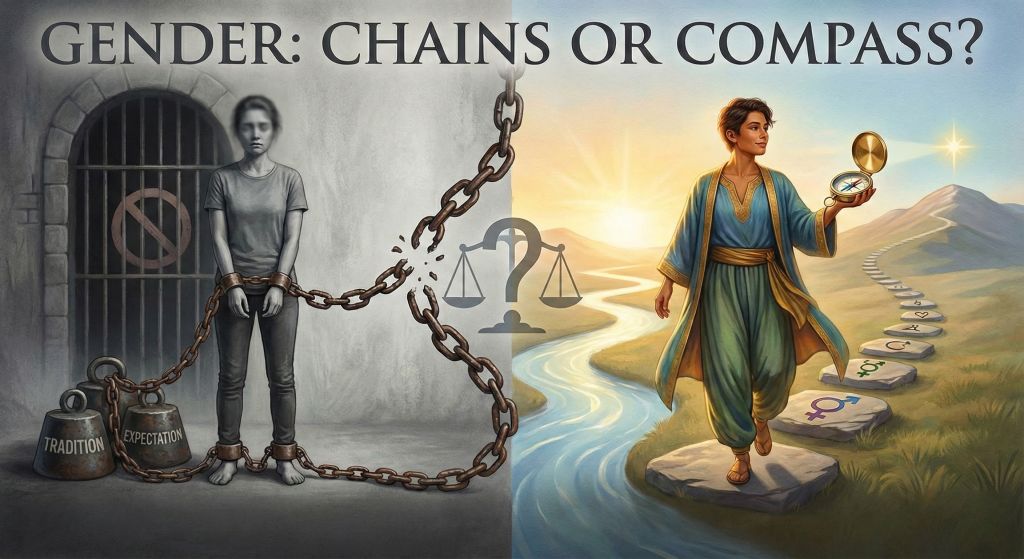
Walk into any college classroom today and you’ll notice something interesting: the conversations around gender are no longer confined to textbooks or social science lectures; they’re happening in our daily lives. Taking a peek into real life, we see that the acquisition or distribution of leadership is dependent upon gender.
For centuries, societies dictated strict roles for men as providers and women as homemakers. These norms went unquestioned, but our generation, shaped by globalization and evolving values, is now challenging and rethinking these boundaries.
A new reform seen in our generation is that we don’t let gender create boundaries for us. The majority of us believe in living our lives by our own ways and standards and being independent in our choices. For example, more men today are confidently pursuing careers in nursing, teaching, or fashion design – fields once considered “feminine” .Whereas the masculine roles like engineers, lawyers, and architects are now fulfilled by women, breaking those years-old norms and paving the way for generations to come. On our own campus, I’ve noticed female students leading robotics teams while male students experiment with culinary clubs. These are changes, small in size or caliber, but they go on to change the societal perspective on these norms.
A form of rewamp is being seen in friendships. Traditionally, men were often pressured to be strong and avoid vulnerability, while women were seen as the epitome of femininity. However, emotional intelligence and empathy transcend gender, and everyone should cultivate these qualities. This led men to open up emotionally with friends, while women continue to foster authentic and honest friendships. We are embracing a wider emotional landscape beyond traditional gender roles, far from society’s boundaries.
Media plays a crucial role in publicizing the revolution, while social media lets the younger generation express themselves. Social Movements foster open discussions and celebrate diverse gender expressions, despite the toxicity sometimes found online.
Of course, it would be unfair to claim that the battle for gender equality has been won. Even within our generation, stereotypes and biases remain. Women still face harassment on the streets, in workplaces, and on campuses. Men are often mocked for choosing non-traditional careers or showing vulnerability. Non-binary and transgender individuals struggle with acceptance, and often their gender or their personality is taken as a joke or even used as an insult or abuse. These things show that we haven’t yet come out of the centuries-old dogma, but rather are just trying to change some superficial aspects, while letting some stay the same.
In this extreme patriarchal society like Pakistan, where an issue like equality of gender is raised, it is criticized not only by the men of the society but also by the women of the society, as at the base level, our women haven’t known what their rights allow them to. There is a concern that addressing this issue may lead to perceptions of impropriety and push individuals beyond societal boundaries. The influence of scholars and muftis has often shaped the perception of women as subordinate to men, which contradicts the principles of Islam and upholds women’s rights. The effect of this on society is forced marriages and honor-related violence, undermining the need for a more unprejudiced comprehension of gender roles.When a movement like feminism tries to interfere and speak for the rights of women, they are either silenced or their support backs down. This is due to the problem that there is only an elite cream that knows what this movement stands for and how it benefits society, but the middle-class women have been trapped inside such a cage that doesn’t even let the light of their rights shine on it. The problem is that we raise our sons and daughters in the absolute opposite way, leading to the development of an inferiority complex of not going out, while your own brother is allowed to go late at night, have dinners, etc , while the daughter even has to struggle and fight to study and be someone independent.
But we can’t ignore the fact that how alone a man stands when he is at his lowest cause if he goes to his parents for support he is a failed son still leaching of of his parents, if he shares his problem with his wife he becomes weak infront of the one to whom he promised to take care of, and if he turns to his friends for help they will help without hesitation but he won’t be able to meet him eye to eye. So it ain’t that men don’t face the societal hardships, they have to keep their nose to the grindstone and keep pushing to fit the mold. I heard an influential being in my life once say ” It is the incompetence of man to fail in a patriarchal society like Pakistan ” to which i will say be it man or women to not let them open their wings to sear the sky or to not pick them up when they scrape their knees is both the failure of a society which we need to change.
Think of a generation of people passed as a glass of water that was handed over to us filled to the brim with old, nasty water, but as we fill it up with clean and safe water a time will come the nasty water will be replaced by clean water and would make way for the next generation into a clean society free of past dogmas and restraints.
Equality isn’t about one gender winning over another–it’s about creating a society where everyone has the freedom to define themselves on their own terms.

Written By:
Muhammad Yahya Lateef
XII Class – UDL Section